Introduction
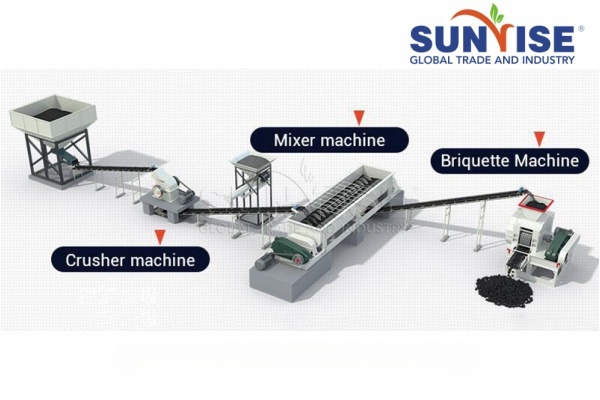
Rice husk is an abundant byproduct of rice production, often considered agricultural waste. However, it holds significant potential as a raw material for making charcoal briquettes. Charcoal briquettes made from rice husk are not only an efficient source of energy but also a sustainable and eco-friendly alternative to traditional fuels. This passage will guide you through the process of making small-scale rice husk charcoal briquettes, covering the preparation, carbonization, briquetting process, equipment needed, and the benefits of this practice.
Preparation
Collecting and Drying Rice Husk
The first step in making rice husk charcoal briquettes is to collect rice husks from paddy fields or rice mills. It is essential to ensure that the rice husks are free from contaminants like stones or soil. After collection, the rice husks need to be thoroughly dried to reduce moisture content. Moisture can hinder the carbonization process and affect the quality of the final briquettes. Spread the rice husks in a thin layer under the sun and allow them to dry for several days, turning them periodically to ensure even drying.
Grinding Rice Husk
Once dried, the rice husks should be ground into finer particles. This can be done using a small-scale grinder or a hammer mill. Fine particles are easier to carbonize and briquette, resulting in a more uniform and stable product.
Carbonization
Setting Up the Carbonization Kiln
The carbonization stage involves converting the rice husks into charcoal. Small-scale carbonization can be achieved using a simple drum kiln or a pit kiln. The drum kiln is more portable and convenient for small-scale operations. To set up a drum kiln, cut the top of an old oil drum and drill holes around the base for air circulation.
Carbonizing the Rice Husk
Fill the drum kiln with the ground rice husk and light a fire at the bottom. Allow the rice husk to burn slowly, ensuring that it undergoes controlled combustion to avoid turning into ash. The process typically takes several hours, and it’s essential to monitor the kiln closely. Once the rice husk turns into black charcoal, extinguish the fire by covering the kiln and allowing it to cool down completely.
Briquetting Process
Mixing with Binder
To form briquettes, the charcoal powder needs to be mixed with a binder. Common binders include starch, clay, or molasses. Mix the charcoal powder with the binder in a ratio of about 5:1 (charcoal to binder) to achieve a consistent and moldable mixture.
Molding the Briquettes
Once the mixture is ready, it can be formed into briquettes using a manual press or a briquette mold. For small-scale production, a simple hand-operated briquette press will suffice. Fill the mold with the mixture and apply pressure to form compact briquettes. Release the briquettes from the mold and place them on a drying rack.
Drying the Briquettes
Allow the newly formed briquettes to dry naturally under the sun for several days. Proper drying is crucial to ensure that the briquettes are strong and long-lasting. Turn the briquettes periodically to ensure even drying.
Equipment Needed
Manual Briquette Press
A manual briquette press is essential for small-scale production. It is cost-effective and easy to use. The press typically consists of a lever-operated mechanism that compresses the charcoal mixture into briquette shapes.
Grinder or Hammer Mill
A grinder or hammer mill is required to grind the dried rice husks into fine particles. This equipment ensures that the rice husks are adequately prepared for the carbonization process.
Drum Kiln
A drum kiln is a simple and effective tool for small-scale carbonization. It can be easily constructed from an old oil drum and is portable enough for small operations.
Benefits of Rice Husk Charcoal Briquettes
Sustainable and Eco-Friendly
Using rice husk to make charcoal briquettes promotes waste utilization and reduces the reliance on wood charcoal, helping to conserve forests and reduce deforestation. It also provides a sustainable energy source for households and small businesses.
Cost-Effective
Rice husk is an inexpensive and readily available raw material. The process of making rice husk charcoal briquettes is relatively simple and does not require significant capital investment, making it an affordable option for small-scale producers.
High Energy Efficiency
Rice husk charcoal briquettes have a high calorific value, making them an efficient source of energy. They burn longer and produce less smoke compared to traditional wood charcoal, improving indoor air quality and reducing health risks.
Conclusion
Making small-scale rice husk charcoal briquettes involves collecting and drying rice husks, carbonizing them in a drum kiln, mixing the charcoal powder with a binder, and molding and drying the briquettes. This process is relatively simple and requires minimal equipment. The benefits of rice husk charcoal briquettes, including sustainability, cost-effectiveness, and high energy efficiency, make them an attractive option for small-scale producers and households alike. By adopting this practice, individuals can contribute to environmental conservation while meeting their energy needs in a sustainable manner.
Leave a Reply